
Best MERV Rating for Florida Allergies at Home
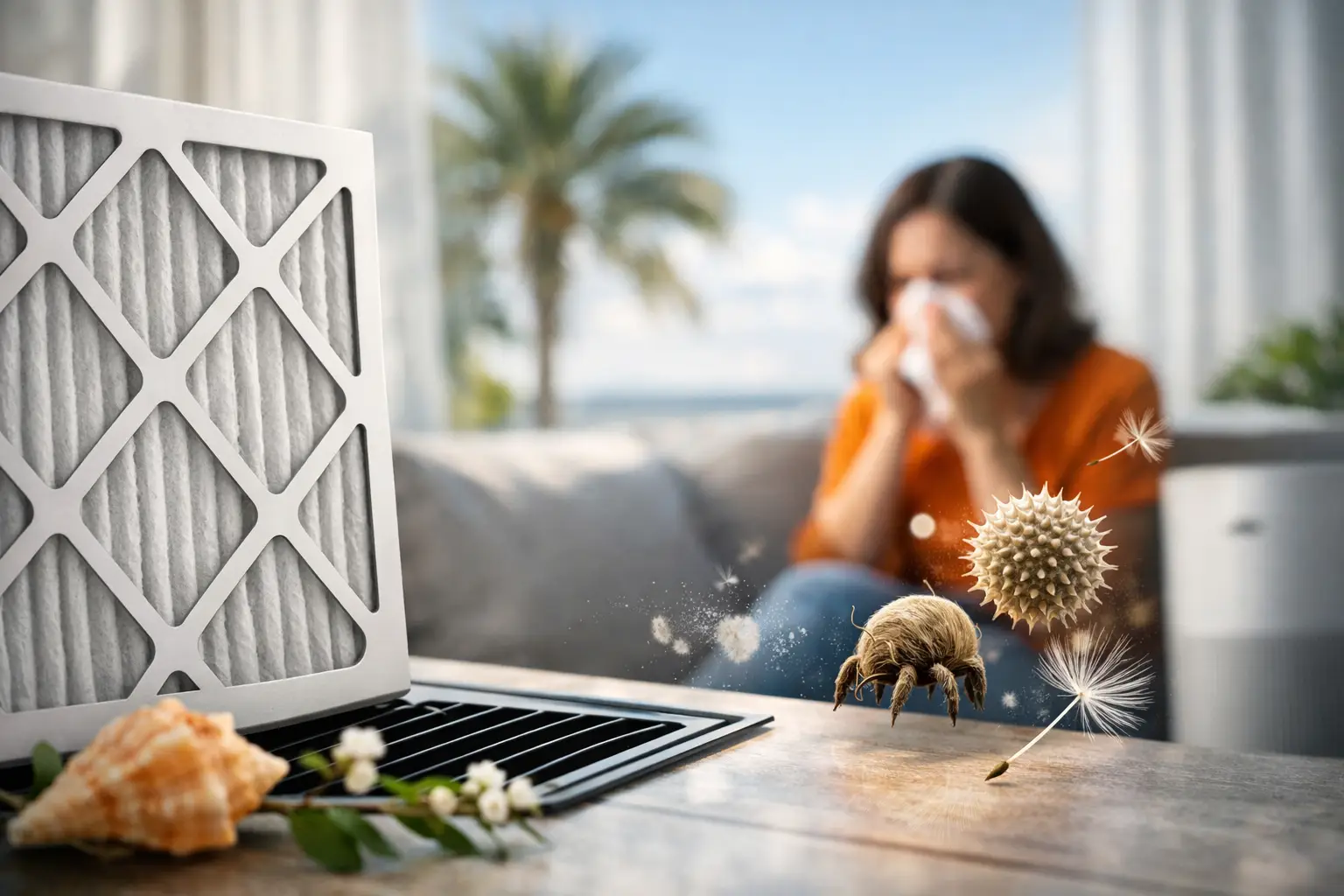
A Florida allergy season can feel like it never fully ends. Pollen comes and goes, humidity encourages mold, and every trip in and out of the house can bring fine particles indoors. Choosing the right MERV rating for Florida allergies can help your central HVAC system capture more of those airborne irritants without making your AC work harder than it should.
For many Central Florida homes, a quality MERV 11 filter is a practical starting point. MERV 13 can provide stronger filtration for some households, but it is not automatically the right choice for every system. The best filter is one that improves indoor air quality while still allowing enough airflow to protect cooling performance, comfort, and energy use.
What a MERV Rating Actually Tells You
MERV stands for Minimum Efficiency Reporting Value. It is a filter rating that indicates how effectively an air filter captures particles of different sizes as air moves through your HVAC system. A higher number generally means the filter can trap smaller particles.
That matters when allergies are the concern. Common Florida indoor and outdoor irritants include tree, grass, and weed pollen; mold spores; pet dander; dust; and dust-mite debris. Not all of these particles are the same size, and no standard HVAC filter removes every possible allergen. Still, the right filter can reduce the amount of airborne material circulating through your home.
A MERV rating is not a measure of how much air your system can move. In fact, higher-efficiency filters can create more resistance to airflow. If a filter is too restrictive for your equipment, your AC may run longer, cool unevenly, freeze up, or experience unnecessary strain. In Florida, where the AC often runs for much of the year, that trade-off deserves attention.
MERV 8, 11, or 13 for Florida Allergies?
The best choice depends on your household, your HVAC equipment, and the filter cabinet or return grille in your home. Here is how the most common residential options compare.
MERV 8: Basic Household Filtration
MERV 8 filters are common in many homes. They do a solid job catching larger airborne debris, including lint, larger dust particles, pollen, and some mold spores. They also tend to have relatively low airflow resistance.
For a household without major allergy concerns, MERV 8 may be enough. However, it may not capture as much fine dust, pet dander, or smaller mold particles as a higher-rated filter. If someone in the home regularly deals with allergy symptoms, a step up is often worthwhile if the system can support it.
MERV 11: The Strong All-Around Choice
For many homeowners, MERV 11 offers the best balance between filtration and airflow. It captures more fine particles than a MERV 8 filter, including a greater share of pet dander, dust, and some smaller allergy-related particles.
This rating is often a sensible choice for Florida families, homes with pets, and households where seasonal allergies are a recurring problem. It can improve filtration without the airflow penalty that sometimes comes with more restrictive options.
Filter quality still varies by manufacturer, and a MERV 11 filter must fit correctly to work as intended. Air will take the path of least resistance. If the filter is bent, undersized, or loosely installed, unfiltered air can move around it instead of through it.
MERV 13: Better Fine-Particle Capture, With Conditions
MERV 13 filters can capture a higher percentage of small airborne particles. They are often considered when a household has significant allergies, asthma concerns, frequent mold issues, or a strong need for improved particle filtration.
The caution is airflow. A MERV 13 filter may be too restrictive for some older systems, single-return setups, or systems using a narrow one-inch filter slot. Installing one without considering the system can create problems that cost more than the air-quality benefit.
A technician can check whether your equipment has adequate return-air capacity and whether a thicker media cabinet would help. A four-inch or five-inch filter generally provides more surface area than a one-inch filter, which can reduce resistance while delivering higher filtration. That is often a better long-term solution than forcing a dense one-inch filter into a system that was not designed for it.
Why Florida Homes Need More Than a Better Filter
A filter is part of an indoor air quality plan, not the whole plan. Florida humidity changes the conversation because moisture supports mold growth and makes dust mites more comfortable. If indoor humidity stays high, even an excellent filter cannot solve the source of the problem.
Most homes are more comfortable when indoor relative humidity is generally kept around 45% to 55%. Your air conditioner removes moisture as it cools, but an oversized system, short cycling, dirty coils, refrigerant issues, leaky ducts, or thermostat settings can reduce effective dehumidification. A system that cools quickly but shuts off too soon may leave the home cool and clammy.
Mold can also begin in places a return-air filter cannot address well, such as bathrooms, around plumbing leaks, under sinks, or inside poorly ventilated spaces. Address visible moisture and water intrusion promptly. Keep bathroom exhaust fans running after showers, and make sure dryer vents exhaust outdoors.
Outdoor pollen still gets inside through open doors, windows, clothing, pets, and gaps around the home. During high-pollen periods, keeping windows closed and using the AC can reduce the amount of pollen entering the house. A clean filter then helps capture what does make it indoors.
Signs Your Filter Choice Is Hurting HVAC Performance
More filtration is not always better if your system cannot move air through it properly. Watch for warning signs after changing to a higher-MERV filter: weak airflow from supply vents, rooms that no longer cool evenly, longer cooling cycles, a whistling return grille, or ice on the refrigerant line or indoor equipment.
A dirty filter can cause similar symptoms. In Central Florida, a one-inch filter may need attention every 30 to 60 days, especially in homes with pets, active families, construction nearby, or frequent AC use. Larger media filters can often last longer, but they still need regular inspection. Follow the filter manufacturer’s guidance and adjust based on what you see.
Do not wait until the filter looks completely packed with dust. Restricted airflow can raise operating costs and put added stress on the blower motor, evaporator coil, and compressor. If your AC suddenly stops keeping up with the heat, checking the filter is a simple first step, but persistent trouble calls for professional service.
Getting Better Results From Your HVAC Filter
Start by confirming the filter size printed on the existing filter or filter cabinet. Measure only if the label is missing, and do not substitute a near match. Even a small gap can let unfiltered air bypass the filter.
Install the filter with the airflow arrow pointing toward the equipment, which is usually toward the air handler or furnace. If you are unsure, look at the direction air is pulled through the return grille. A filter installed backward may still catch some debris, but it can perform poorly and may sag or deform.
Keep return grilles clear of furniture, rugs, and storage. Your AC needs enough return air to operate correctly, especially when using a more efficient filter. Closing too many supply vents to force cooling into one area can also upset airflow balance and increase system strain.
If allergies are persistent, consider the full picture: filter rating, humidity control, duct condition, coil cleanliness, and whether the system is correctly sized. Portable air cleaners can also help in bedrooms or other high-use rooms, but they should supplement a well-maintained HVAC system rather than replace needed repairs or maintenance.
When to Ask a Professional
It is a good idea to ask for guidance before moving from MERV 8 to MERV 13, particularly if your system is older, airflow already seems weak, or you use a one-inch filter. A technician can evaluate static pressure, return-air capacity, duct restrictions, and the condition of the indoor coil. Those details determine whether a higher-rated filter is a benefit or a burden.
Professional preventive maintenance can also identify dirt buildup and drainage issues that affect both efficiency and humidity control. If your home feels damp, dusty, or unevenly cooled even with a fresh filter, there may be a system issue worth correcting. Savage Heating & Air can help Central Florida homeowners evaluate filtration and indoor air quality options in practical terms, without pushing a filter rating their system cannot handle.
A clean, properly sized filter is one of the simplest ways to support healthier air at home. Choose the highest MERV rating your HVAC system can handle comfortably, replace it before airflow suffers, and treat ongoing allergy symptoms as a reason to look at the whole indoor environment.
Comfort starts with a call
Same-day HVAC service across Brevard, Orange, Osceola, Seminole & Volusia.
Call 321-804-4413