
High Humidity in Your Florida Home? Why Your AC May Be Running But Your House Still Feels Sticky
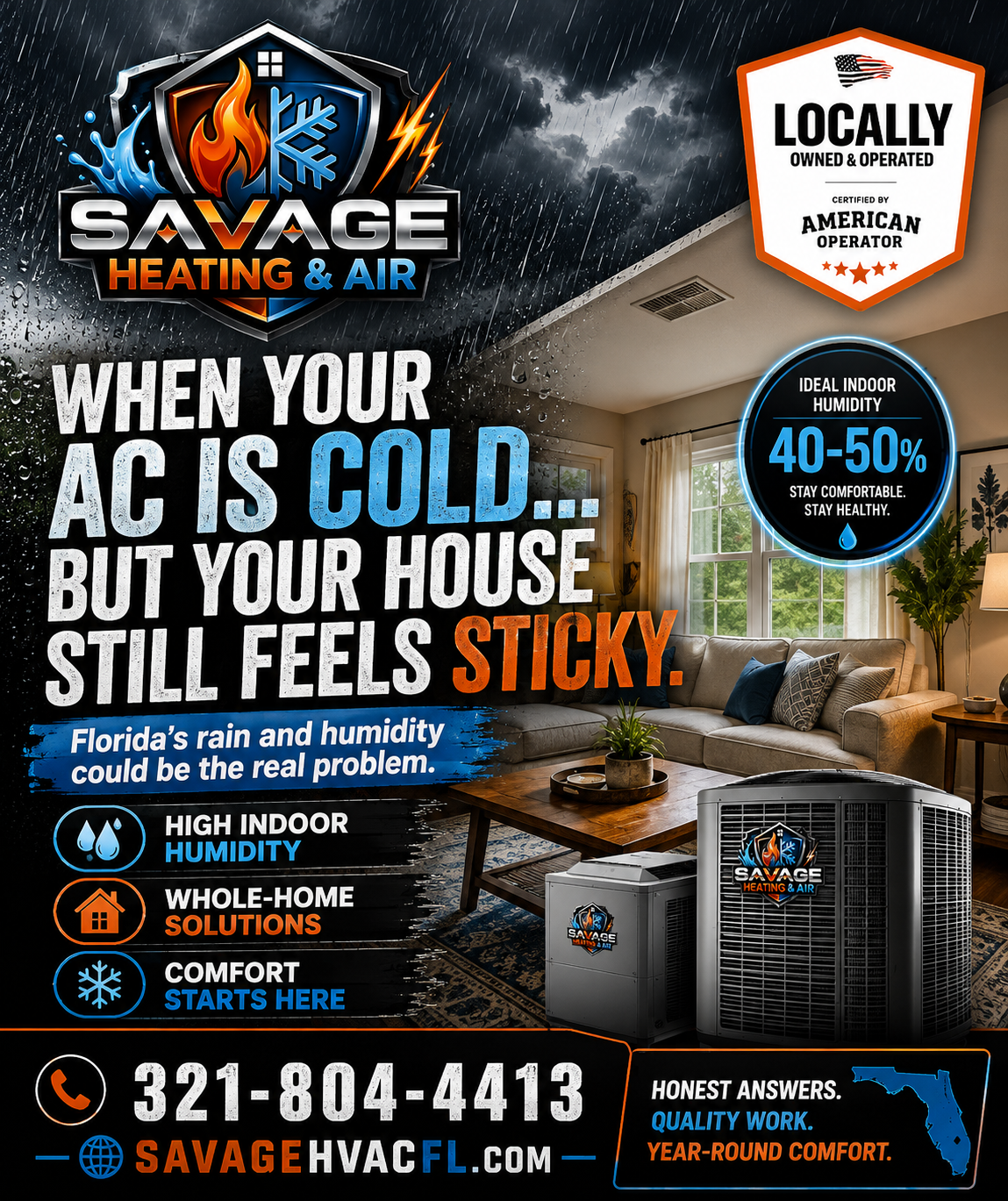
High Humidity in Your Florida Home? Why Your AC May Be Running But Your House Still Feels Sticky
If your air conditioner is running, your thermostat says 72°F, and your house still feels damp or sticky, you may not have a temperature problem.
You may have a humidity problem.
And if you've noticed this lately in Central Florida, you're not imagining it.
Florida's frequent rain, warm temperatures, and naturally humid climate can put a tremendous amount of moisture into the outdoor air. When that humid air makes its way into your home, your HVAC system has to do more than simply cool the temperature.
It also has to remove moisture.
That's an important part of how your air conditioning system keeps your home comfortable.
Why Does Florida Feel So Humid?
Florida is surrounded by water, and our warm climate allows the air to hold a significant amount of moisture.
After periods of heavy rain, the ground, landscaping, roofs, driveways, and other surfaces remain wet. As temperatures rise, moisture returns to the air through evaporation.
That means your air conditioner may be fighting two battles at the same time:
- Cooling the air
- Removing moisture from the air
When humidity levels stay high, your home can feel uncomfortable even when the thermostat shows what should be a comfortable temperature.
That's why a house can be set to 72°F and still feel like something isn't right.
Does an AC Actually Remove Humidity?
Yes.
Your air conditioner does more than produce cold air.
As warm indoor air passes across the cold evaporator coil inside your HVAC system, moisture in that air can condense on the coil.
That moisture becomes water and is collected and drained away through your condensate drainage system.
This is one of the reasons your air conditioning system is such an important part of humidity control.
However, the amount of moisture your system removes depends on several factors.
Your equipment, system sizing, airflow, indoor conditions, ductwork, maintenance, and how long the system operates can all affect humidity control.
Why Does My House Feel Sticky When the AC Is Running?
A sticky house doesn't necessarily mean your air conditioner isn't cooling.
It can mean the system is cooling the air faster than it is removing the moisture.
Several things can contribute to this problem.
An Oversized AC System
An air conditioner that is too large for the home may cool the temperature very quickly.
That sounds like a good thing—but it isn't always.
Air conditioning systems need sufficient operating time to remove moisture effectively.
If the system satisfies the thermostat too quickly and shuts off, it may not have enough run time to provide the humidity control your home needs.
Dirty or Restricted Equipment
A dirty evaporator coil, clogged filter, or airflow restriction can affect how your system operates.
Regular HVAC maintenance helps identify these problems before they turn into larger comfort issues.
Ductwork Problems
Your ductwork is a major part of your HVAC system.
Leaks, poor insulation, or improperly designed ductwork can allow unwanted air into the system or make it more difficult to distribute conditioned air properly.
In Florida, ductwork located in hot attic spaces deserves particular attention.
Condensate Drain Problems
Your HVAC system removes moisture from the air, but that water has to go somewhere.
If the condensate drain becomes clogged or the drainage system isn't operating correctly, your system can experience problems removing and managing moisture.
What Are the Signs of High Indoor Humidity?
Your home may be telling you that humidity is becoming a problem.
Some common signs include:
- Your house feels sticky or clammy.
- The thermostat shows a comfortable temperature, but the home doesn't feel comfortable.
- Rooms have a musty smell.
- You notice condensation on windows or other cool surfaces.
- Your HVAC system seems to run for long periods.
- Certain rooms feel noticeably more uncomfortable than others.
- You notice mold or mildew concerns.
- Your home feels damp after rainstorms.
- Your family is constantly adjusting the thermostat.
None of these symptoms automatically means you need a new air conditioner.
That's why proper diagnosis matters.
What Is the Best Indoor Humidity Level?
For most homes, indoor relative humidity is generally best kept in a comfortable range rather than allowed to remain excessively high.
A relative humidity reading around 40%–50% is often a comfortable target for many homeowners.
A simple digital hygrometer can tell you what your home's indoor humidity is actually doing.
That's useful information because your thermostat may tell you the temperature—but it may not tell you how humid your home is.
Can an AC Be Too Cold But Still Too Humid?
Absolutely.
This is one of the most confusing HVAC problems for homeowners.
You can have a home that is technically cold enough but still feels uncomfortable.
Think about the difference between stepping into a cool, dry room and stepping into a cool, damp room.
The thermometer might show a similar temperature.
Your body won't necessarily experience them the same way.
That's why temperature isn't the only measurement of comfort.
Humidity matters too.
What Can Be Done About High Humidity?
The right solution depends on what's causing the problem.
A professional HVAC evaluation may include checking:
- System sizing
- Airflow
- Filter condition
- Evaporator coil condition
- Condensate drainage
- Ductwork
- Duct insulation
- Thermostat operation
- Indoor humidity levels
- Overall system performance
Depending on what is found, the solution may be relatively simple.
It could involve improving airflow, correcting a drainage issue, servicing the equipment, sealing ductwork, addressing insulation problems, or making another adjustment to the existing system.
Sometimes, however, the home has a legitimate need for additional humidity control.
What Is a Whole-Home Dehumidifier?
A whole-home dehumidifier is a dedicated system designed specifically to remove moisture from the air throughout your home.
It works alongside your existing HVAC system.
This can be particularly useful in Florida homes where humidity remains high even when the air conditioner is operating properly.
A whole-home dehumidifier may help:
- Improve indoor comfort
- Reduce that sticky feeling
- Control excess moisture
- Help protect your home from moisture-related problems
- Allow your HVAC system to focus on temperature control
It isn't automatically the right answer for every house.
The first step should always be determining why your home has excessive humidity in the first place.
Humidity Problems Don't Always Mean You Need a New AC
This is something we believe homeowners should know.
If your house feels humid, the answer isn't automatically:
"You need a new air conditioner."
Sometimes the existing equipment is perfectly capable of doing the job.
The problem may be airflow, ductwork, maintenance, drainage, sizing, insulation, or another issue that can be corrected.
That's why we believe in diagnosing the problem before recommending a solution.
What Can Homeowners Do Right Now?
There are a few simple things you can do to better understand what's happening inside your home.
1. Check Your Indoor Humidity
Pick up an inexpensive digital hygrometer and see what your indoor relative humidity actually measures.
Don't guess.
Measure it.
2. Check Your Air Filter
A dirty filter can restrict airflow and affect system performance.
Follow your equipment manufacturer's recommendations for filter replacement.
3. Pay Attention After Heavy Rain
Notice how your home feels after several days of rain.
If the temperature seems comfortable but the house suddenly feels damp or sticky, humidity may be playing a major role.
4. Look for Musty Odors or Moisture
Musty smells, condensation, or visible moisture deserve attention.
They may be signs that your home has more moisture than it should.
5. Have the HVAC System Evaluated
If the problem continues, have a qualified HVAC professional evaluate the complete system rather than simply lowering the thermostat.
Florida Comfort Is About More Than Temperature
Living in Central Florida means dealing with heat and humidity.
Your HVAC system has an important job—not only keeping your house cool, but helping manage the moisture that comes with our climate.
If your home feels sticky even when the AC is running, don't automatically assume you need to turn the thermostat lower.
The real problem could be humidity.
And the right solution starts with understanding what's actually happening inside your home.
Savage Heating & Air: Honest Answers. Real Solutions.
At Savage Heating & Air, we believe homeowners deserve to understand what's happening with their HVAC system before making a major repair or replacement decision.
We'll look at the actual problem, explain what we find, and discuss your options.
Sometimes the solution is maintenance.
Sometimes it's a repair.
Sometimes it's an airflow or ductwork correction.
And sometimes a home genuinely benefits from dedicated humidity control such as a whole-home dehumidifier.
The important thing is finding the right solution for your home.
If your Central Florida home feels sticky, damp, or uncomfortable even when your AC is running, Savage Heating & Air can help you find out why.
Comfort isn't just about cold air. It's about comfortable air.
Comfort starts with a call
Same-day HVAC service across Brevard, Orange, Osceola, Seminole & Volusia.
Call 321-804-4413