The Truth About AC Capacitors: The Small Part That Can Shut Down Your Air Conditioner
The Truth About AC Capacitors: The Small Part That Can Shut Down Your Air Conditioner
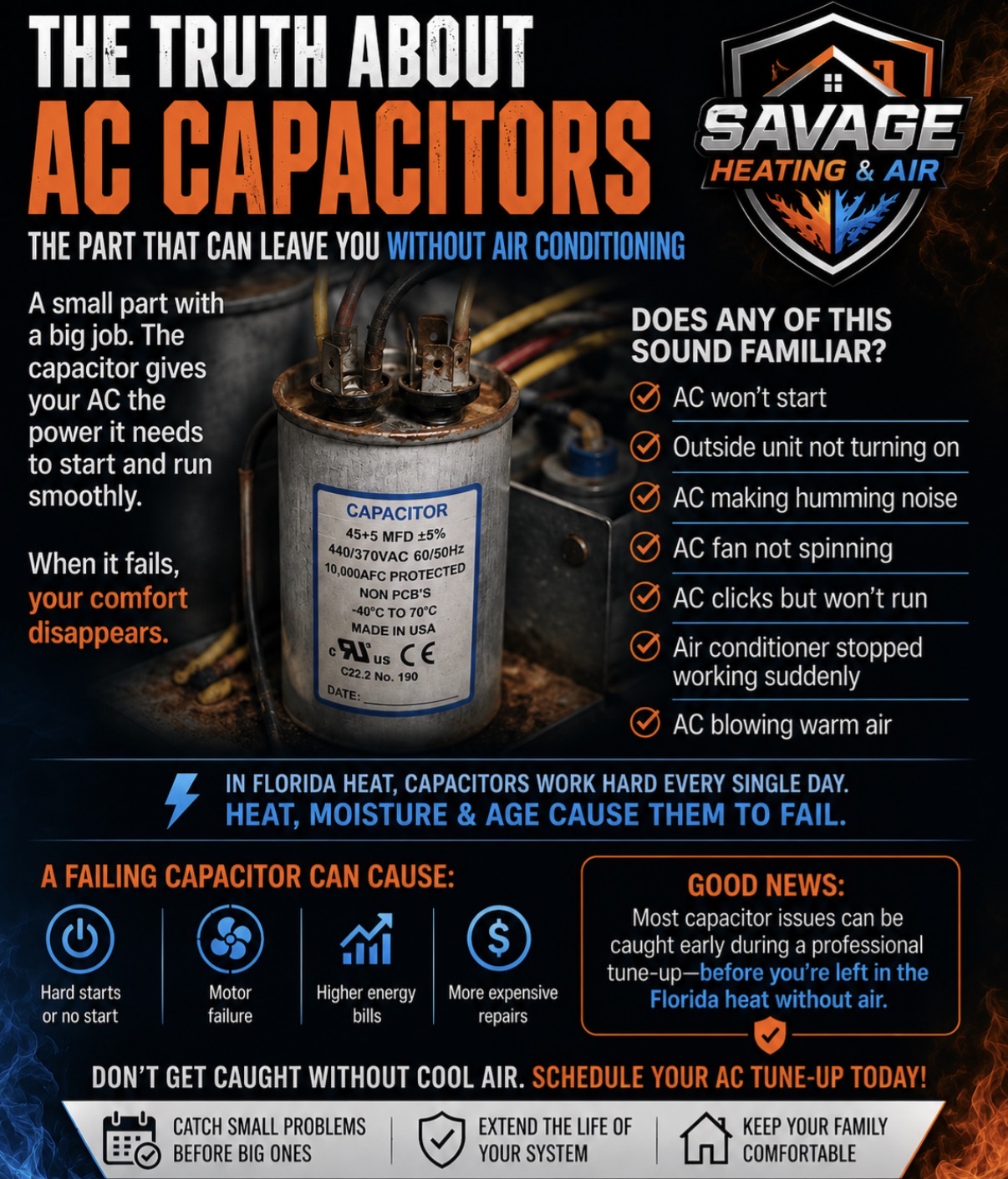
If your air conditioner suddenly stops working on a hot Florida afternoon, you may find yourself searching:
- Why won't my AC start?
- Why isn't my outside AC unit turning on?
- Why is my AC making a humming noise?
- Why isn't my AC fan spinning?
- Why does my AC click but won't run?
- Why did my air conditioner suddenly stop working?
- Why is my AC blowing warm air?
There are several possible reasons an air conditioner can experience these problems, but one small electrical component is often involved: the capacitor.
Understanding what a capacitor does and recognizing the warning signs of a possible failure can help homeowners know what they are seeing when their AC isn't operating properly.
What Is an AC Capacitor?
An air conditioner capacitor is an electrical component that helps provide the starting and operating power needed by certain motors in your HVAC system.
Your outdoor air conditioning unit relies on motors to operate components such as the compressor and condenser fan motor.
The capacitor helps those motors start and continue operating properly.
Think of it as an electrical boost that helps your AC motors do their job.
Although the capacitor itself is relatively small, a failure can prevent an entire air conditioning system from operating correctly.
Why Do Capacitors Fail?
Air conditioning systems in Central Florida work hard.
Unlike many parts of the country where an air conditioner may only operate for a few months each year, Florida cooling systems can run for long periods throughout the year.
That means components are exposed to significant operating time and repeated electrical and thermal stress.
Some factors that can contribute to capacitor problems include:
- Long cooling seasons
- High outdoor temperatures
- Frequent system operation
- Age and normal component wear
- Electrical stress
- Heat exposure
- Other problems within the HVAC system
A capacitor can eventually weaken or fail just like other electrical and mechanical components.
What Are the Signs of a Bad AC Capacitor?
A capacitor problem can sometimes produce noticeable symptoms.
Here are some of the searches homeowners commonly make when they are experiencing an AC problem:
AC Won't Start
If your thermostat is calling for cooling but the outdoor unit doesn't start, there may be an electrical problem preventing the system from operating.
A failed capacitor is one possibility, but it isn't the only one.
The Outside Unit Isn't Turning On
Your indoor blower may be running while the outdoor condenser isn't operating.
This can happen for several reasons, including electrical problems, thermostat issues, safety controls, contactor problems, or capacitor failure.
Your AC Is Making a Humming Noise
A humming sound from the outdoor unit without normal operation can indicate that a motor is receiving power but isn't starting correctly.
A capacitor problem is one possibility.
Do not assume that every humming sound means the capacitor is bad. A qualified HVAC technician should diagnose the actual cause.
The AC Fan Isn't Spinning
If the outdoor condenser fan isn't operating while the system is calling for cooling, there may be an electrical or mechanical issue.
A failed capacitor can prevent a fan motor from starting.
Your AC Clicks But Won't Run
Hearing a click from the outdoor unit without the system starting can indicate that a control or electrical component is not allowing the system to operate properly.
Again, a capacitor is one possible cause—but proper diagnosis matters.
Your Air Conditioner Suddenly Stopped Working
Sudden AC failures can happen for many reasons.
Electrical components can fail without much warning, especially after years of operation.
A capacitor may be involved, but homeowners should avoid replacing parts based solely on symptoms.
Your AC Is Blowing Warm Air
Warm air coming from your vents does not automatically mean you have a refrigerant problem.
Your system could have an electrical issue, airflow problem, compressor problem, thermostat issue, or another mechanical problem.
A professional diagnosis is the best way to determine what's actually happening.
Does a Bad Capacitor Mean the Entire AC Is Bad?
No.
This is an important distinction for homeowners.
A failed capacitor does not automatically mean your air conditioner needs to be replaced.
In some situations, the capacitor itself may be the component that has failed while the rest of the system remains operational.
However, the technician should determine why the capacitor failed and whether other components have been affected.
Simply replacing a part without understanding the underlying problem isn't always the best approach.
Can a Weak Capacitor Damage Other Components?
A weak or failing capacitor can cause a motor to struggle to start or operate properly.
That can place additional stress on components such as the compressor or fan motor.
Because those components can be considerably more expensive than a capacitor, identifying electrical problems early can be important.
This is one reason professional HVAC maintenance can be valuable.
Why Florida AC Maintenance Matters
Your air conditioner is one of the hardest-working appliances in your Florida home.
During a professional maintenance visit, a qualified HVAC technician can inspect and test important components of the system, including electrical components.
Depending on the equipment, maintenance may include checking:
- Capacitor condition
- Electrical connections
- Voltage and amperage
- Motors
- Contactors
- Condenser coil condition
- Airflow
- Refrigerant-related operating conditions
- Filters
- Thermostat operation
- Overall system performance
The goal isn't simply to find something to replace.
The goal is to identify problems, document the system's condition, and help the homeowner understand what their equipment needs.
Should You Replace an AC Capacitor Yourself?
We strongly recommend allowing a qualified HVAC professional to diagnose and replace HVAC capacitors.
Capacitors can store electrical energy even after power to the equipment has been turned off.
Working inside an air conditioning condenser involves electrical components and can be dangerous without the appropriate training, tools, and procedures.
If you suspect a capacitor problem, shut the system down and have the equipment properly inspected rather than attempting to diagnose or replace the component yourself.
The Bottom Line
An AC capacitor may be a small part, but it can have a major impact on whether your air conditioner starts and operates properly.
If your AC won't start, the outdoor unit isn't turning on, the fan isn't spinning, you're hearing a humming or clicking noise, your system suddenly stopped working, or you're getting warm air from the vents, don't automatically assume you know what's wrong.
Those symptoms can have multiple causes.
The right answer is a proper diagnosis.
At Savage Heating & Air, we believe homeowners deserve to understand what is happening with their HVAC system—not simply receive a repair recommendation without an explanation.
We'll explain:
- What we found
- What caused the problem
- What your repair options are
- What can potentially help prevent the problem from happening again
No pressure. No guesswork. Just honest information and professional HVAC service.
If your AC is acting differently than normal, don't wait until a small problem becomes a complete no-cool emergency.
Savage Heating & Air — Local HVAC. Real People. No Private Equity Overhead.
Serving Central Florida and the Space Coast.
Comfort starts with a call
Same-day HVAC service across Brevard, Orange, Osceola, Seminole & Volusia.
Call 321-804-4413