
What the SEER2 Rating Means for Your Energy Bill in Florida
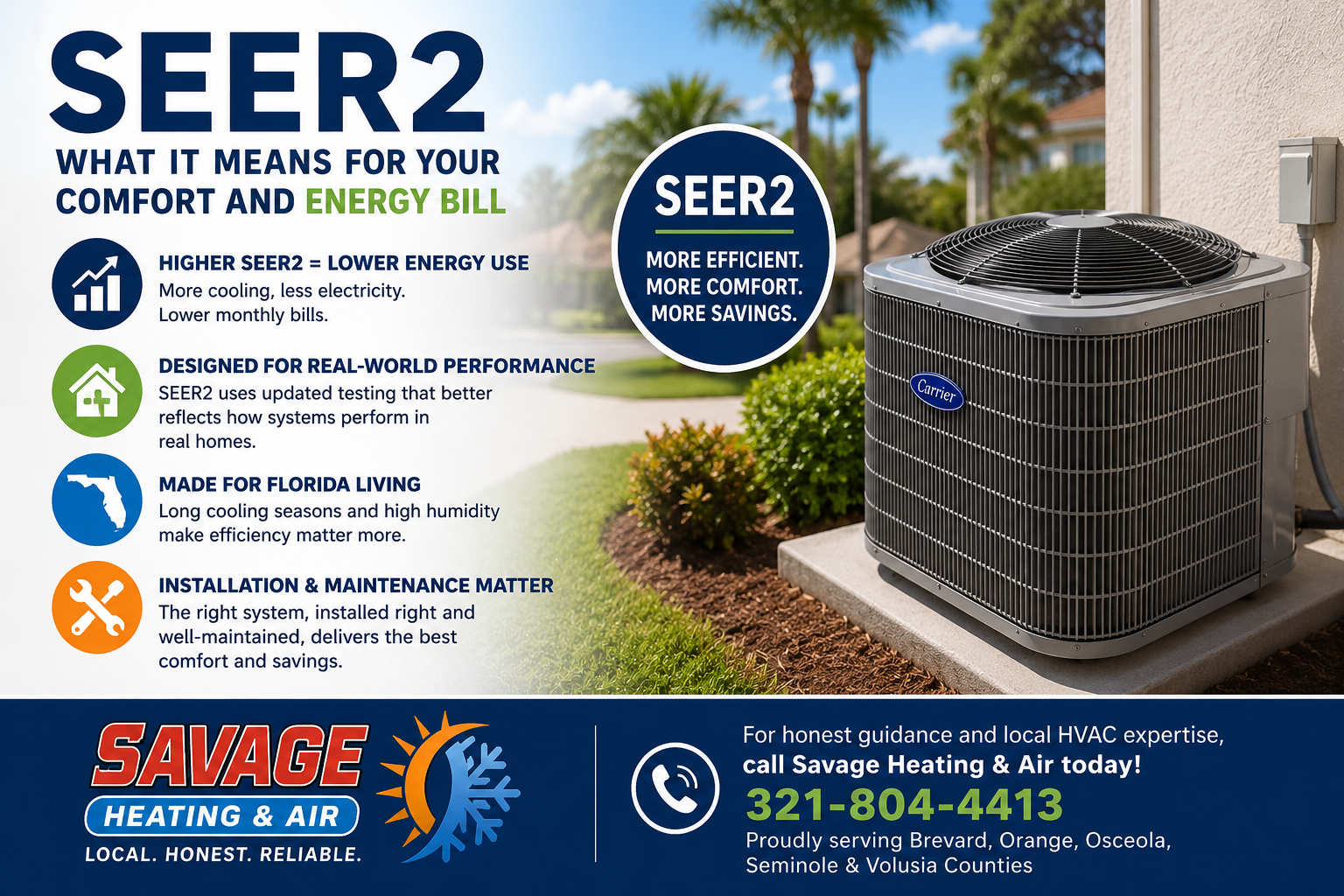
What SEER2 Actually Measures
SEER2 stands for Seasonal Energy Efficiency Ratio 2. It is the updated federal rating used to measure how efficiently an air conditioner or heat pump cools your home over a typical season.
In simple terms, SEER2 tells you how much cooling you get for each unit of electricity you use. The higher the number, the less electricity the system should use to produce the same amount of cooling.
For Florida homeowners, that matters a lot. Our cooling season is long, humidity is high, and many systems run for much of the year. Even a small efficiency difference can show up on your monthly utility bill.
How SEER2 Differs From the Old SEER Rating
SEER2 replaced the older SEER rating in 2023 as part of updated testing standards. The key difference is not just the number itself, but the way the equipment is tested.
SEER2 uses a more realistic pressure testing method that better reflects how HVAC systems perform in real homes, especially when ductwork adds resistance. That means a SEER2 number is generally a more practical indicator of real-world performance than the old SEER rating.
One important note: a SEER2 rating is not directly comparable to an old SEER rating. A unit labeled 16 SEER2 is not the same as a 16 SEER unit from before the change. The numbers changed because the test method changed.
How SEER2 Can Affect Your Electric Bill
The relationship is straightforward: higher SEER2 usually means lower energy use, but only if the system is properly sized and installed.
Here is why the rating matters in Central Florida:
- Your AC may run many hours a day for months at a time.
- Humidity control adds to the workload.
- Older systems often lose efficiency as parts wear down.
- Leaky ducts can waste the benefit of a higher-rated unit.
If your current system is low on refrigerant, has dirty coils, or struggles with airflow, your actual energy use may be much higher than the rating suggests. A high-SEER2 system cannot overcome poor installation or neglected maintenance.
What SEER2 Number Should Florida Homeowners Look For?
There is no single “best” SEER2 number for every house. The right choice depends on your home size, duct condition, insulation, thermostat habits, and how long you plan to stay in the home.
For many Central Florida homeowners, a mid- to high-efficiency system can make sense because cooling is such a large part of annual energy use. But the sweet spot is not always the highest number available.
A very high-SEER2 system may cost more upfront, and the monthly savings may take years to offset that difference. In some homes, improving duct sealing, attic insulation, or airflow can deliver a better return than buying the absolute top-tier unit.
Why Installation Quality Matters as Much as the Rating
A high SEER2 rating is only part of the story. The installer matters just as much.
If the system is oversized, it may short cycle and fail to remove enough humidity. If it is undersized, it may run constantly and never keep up on the hottest afternoons. If the ductwork is poorly designed, the equipment will work harder and use more power.
That is especially important in Florida, where humidity control is just as important as temperature control. A system that cools quickly but leaves the air sticky can still drive up energy use because homeowners lower the thermostat to compensate.
Other Factors That Influence Your Energy Bill
Your SEER2 rating is only one piece of the puzzle. Your actual bill is also affected by:
Thermostat settings
Lowering the thermostat a few degrees can increase runtime significantly during peak summer heat.
Maintenance
Dirty filters, clogged condensate drains, and dirty outdoor coils all reduce efficiency.
Duct leaks
Cool air escaping into the attic or crawlspace is wasted energy.
Home envelope
Poor insulation, air leaks, and sun exposure can all make your AC work harder.
Humidity levels
In humid Central Florida homes, an AC system may need to run longer to properly dehumidify the air, even if the temperature seems fine.
How to Use SEER2 When Shopping for a New System
When comparing equipment, do not focus on SEER2 alone. Ask these questions instead:
- Is the system properly sized for my home?
- How efficient is the matched indoor and outdoor system combination?
- Will my ductwork support the new equipment?
- What comfort features help with humidity control?
- What maintenance will be needed to keep efficiency up?
A knowledgeable HVAC contractor should be able to explain the tradeoff between upfront cost, long-term energy savings, and comfort. That is the kind of guidance that helps you avoid overspending on equipment you do not need.
The Bottom Line for Florida Homeowners
SEER2 is a useful tool for estimating how efficiently your AC uses electricity, but it is not a magic number. In Central Florida’s heat and humidity, the best energy savings come from the right combination of efficient equipment, correct sizing, good ductwork, and regular maintenance.
If your energy bills are climbing or your system is struggling to keep up, a professional evaluation can help you decide whether repair, tune-up, or replacement makes the most sense.
If you want a clear answer for your home in Brevard, Orange, Osceola, Seminole, or Volusia County, contact Savage Heating & Air at 321-804-4413 for honest guidance and local HVAC expertise.
Comfort starts with a call
Same-day HVAC service across Brevard, Orange, Osceola, Seminole & Volusia.
Call 321-804-4413