What to Do When Your AC Stops Working at Night in Central Florida
AC Out at Night? Start With the Basics
In Central Florida, an AC failure at night is more than an inconvenience. Even after sunset, indoor temperatures can stay high, and humidity can make the air feel sticky and hard to sleep in.
Before you assume the worst, take a few minutes to check the most common causes. Many nighttime AC issues are simple, temporary, or tied to a safety shutoff that protects your system from damage.
First, Check the Thermostat
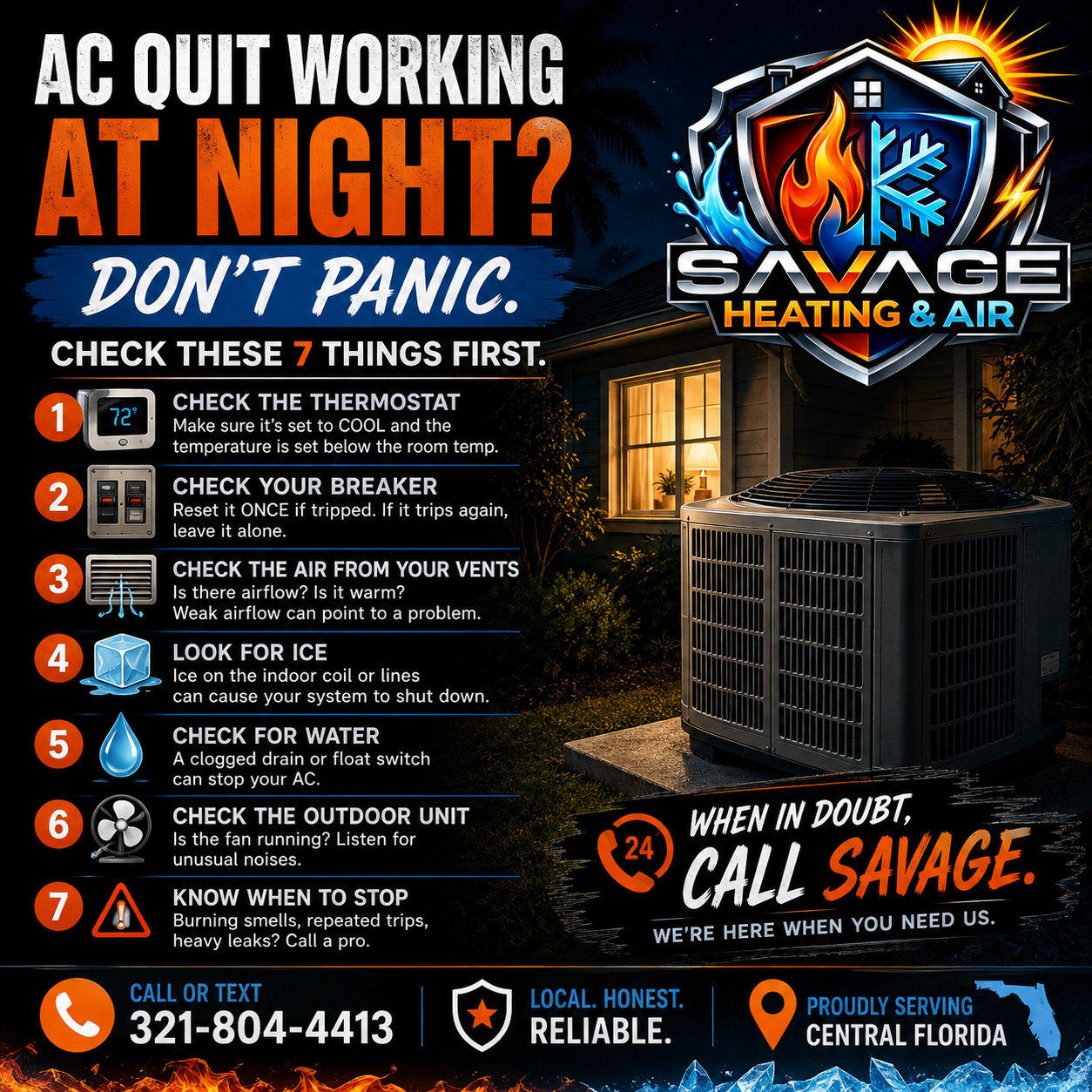
Make sure the thermostat is set to Cool and the temperature is set below the current room temperature.
If the screen is blank, replace the batteries if your model uses them. If the thermostat is programmable or smart, verify that a schedule change or app issue didn’t turn the system off.
Also check whether the fan is set to Auto rather than On. If the fan runs but the AC is not cooling, that helps narrow down the problem.
Check the Circuit Breaker and Power Supply
Your AC may have lost power from a tripped breaker, especially if there was a storm, power surge, or electrical fluctuation.
Look at:
- The indoor air handler breaker
- The outdoor condenser breaker
- Any shutoff switch near the indoor unit
If a breaker is tripped, reset it once. If it trips again right away, stop there and call for service. Repeated tripping often points to an electrical fault, failed motor, or compressor problem.
Inspect the Air Filter and Return Vents
A clogged filter can restrict airflow enough to make the system shut down or stop cooling properly. In Florida, filters often load up faster because AC systems run so much of the year.
Check for:
- A dirty or gray filter
- Closed or blocked supply vents
- Furniture, rugs, or curtains covering return vents
If the filter is dirty, replace it. If airflow is weak, that can be a clue that the evaporator coil may be icing up or the blower may be struggling.
Look for Ice on the Indoor or Outdoor Unit
If your AC is running but not cooling, or the airflow feels weak, inspect the indoor copper lines, the air handler, and the outdoor unit for ice.
Ice usually means one of these issues:
- Dirty air filter
- Restricted airflow
- Low refrigerant
- Blower motor problem
- Dirty evaporator coil
If you see ice, turn the system off and set the fan to On for a few hours to help it thaw. Do not keep running the AC while frozen. That can damage the compressor.
Listen for Warning Signs
Some noises tell you a lot about what failed:
- Clicking but no startup: Possible contactor, capacitor, or control issue
- Buzzing: Electrical problem, failing capacitor, or compressor trouble
- Grinding or squealing: Motor or fan issue
- No sound at all: Power, thermostat, breaker, or safety switch problem
If you smell burning, see smoke, or notice a strong electrical odor, turn the system off immediately.
Use Safe Temporary Cooling Steps
While you wait for help, focus on keeping the home tolerable:
- Run ceiling fans to help air move across skin
- Close blinds and curtains to block overnight heat retained in windows
- Avoid using ovens, dryers, or anything that adds heat indoors
- Keep bedroom doors open if it helps air circulation
- Hydrate, especially for children, older adults, and pets
In Florida humidity, fans help comfort but do not remove moisture. If the home feels clammy, that is normal when the AC is down.
When to Call an HVAC Technician Right Away
Call for service if:
- The breaker keeps tripping
- The system has ice on it after thawing
- The outdoor unit will not start
- You hear loud electrical or mechanical noises
- The home is getting warmer fast
- There is water leaking around the air handler
- You suspect a refrigerant or compressor issue
Nighttime failures often point to parts that are under stress, like capacitors, contactors, blower motors, thermostats, or clogged drain systems. A trained technician can diagnose the root cause safely and prevent a bigger repair.
A Good Nighttime AC Rule for Florida Homes
If your AC stops working at night, start with the thermostat, breaker, filter, and airflow. If you find ice, repeated breaker trips, or anything electrical, shut the system down and call a professional.
For homeowners in Brevard, Orange, Osceola, Seminole, and Volusia counties, Savage Heating & Air is here to help when cooling problems can’t wait. If your AC quits after hours, give us a call at 321-804-4413 for prompt, local service.
Comfort starts with a call
Same-day HVAC service across Brevard, Orange, Osceola, Seminole & Volusia.
Call 321-804-4413