
Why Upstairs Rooms Are Always Warmer in Florida Homes
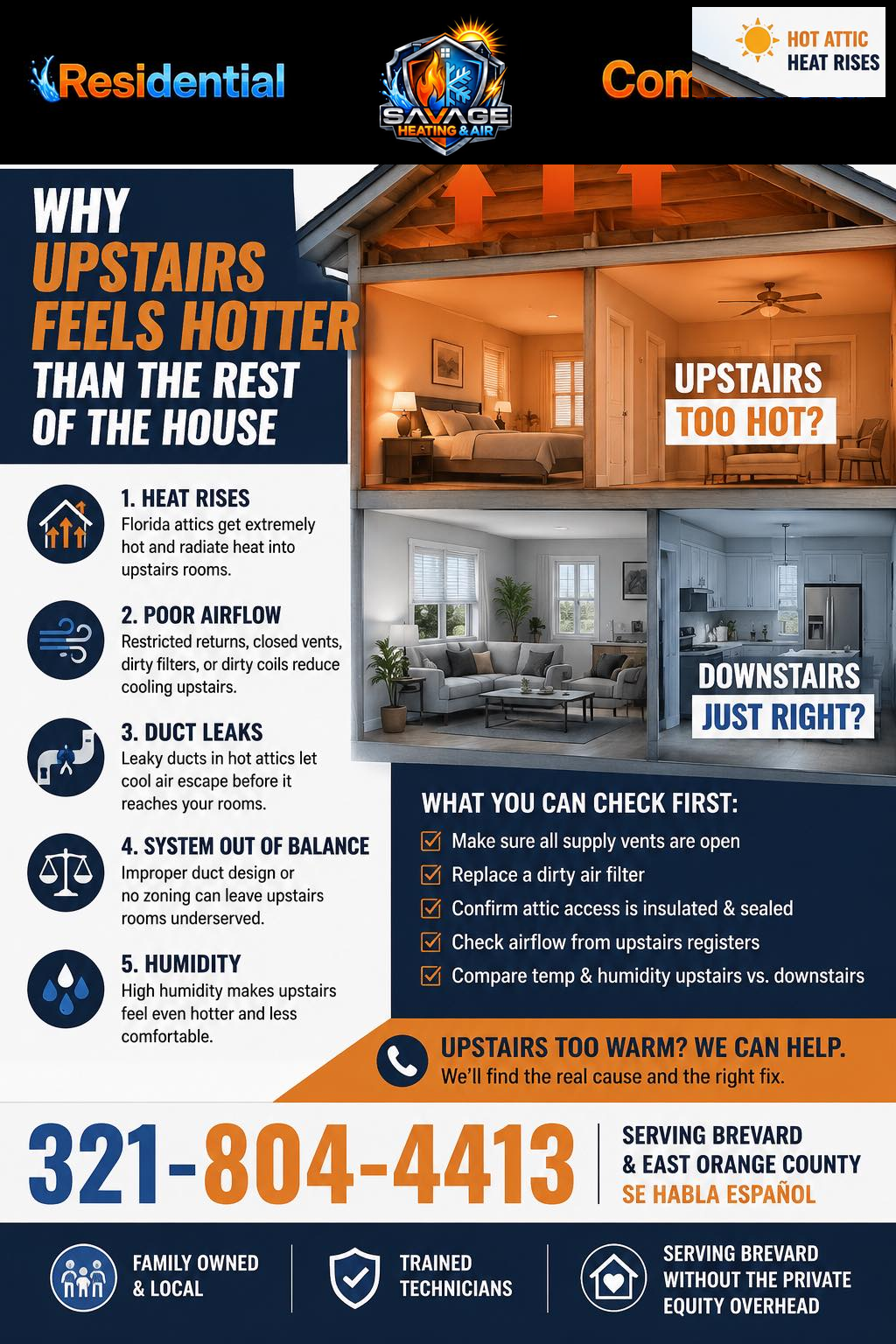
Why Upstairs Feels Hotter Than the Rest of the House
If the rooms upstairs in your home are always warmer, there is usually more than one reason. In Central Florida, this problem is especially common because hot air rises, attics get extremely hot, and air conditioning systems have to work against high humidity for much of the year.
The result is predictable: the first floor feels acceptable, while bedrooms, bonus rooms, and upstairs hallways never quite cool down. In many homes, this is not just a comfort issue. It can also point to airflow problems, duct leakage, or an HVAC system that is not sized or balanced correctly.
1. Heat Rises, and Florida Attics Make It Worse
The basic physics are simple: warm air rises. That alone makes upstairs spaces harder to keep cool.
In Florida, the attic above those upstairs rooms often becomes a heat trap. During summer, attic temperatures can climb far above the outdoor temperature. If insulation is thin, missing, or compressed, that heat radiates straight into the ceiling drywall and into the rooms below it.
That is why a bedroom over the garage or a bonus room over the living area often feels much hotter than the downstairs family room, even when the thermostat says the house should be comfortable.
2. Poor Airflow Usually Shows Up Upstairs First
Uneven cooling is often an airflow issue, not just a “powerful enough AC” issue.
Upstairs rooms are farther from the air handler, so they may already receive less conditioned air. If supply ducts are undersized, damaged, or poorly routed through a hot attic, even more cooling is lost before the air reaches the register.
Common airflow problems include:
Restricted return air
If the system cannot pull enough air back to the air handler, supply air slows down everywhere. Upstairs rooms often feel it first.
Closed or undersized supply vents
Sometimes homeowners close vents to “push” more air elsewhere, but that can worsen static pressure and reduce overall system performance.
Dirty filters or dirty coils
A clogged filter or an evaporator coil coated in dust and grime can reduce airflow and cooling capacity. In Florida, where systems run heavily and humidity stays high, this can happen faster than many homeowners expect.
3. Duct Leaks in the Attic Steal Cooling
Leaky ductwork is one of the most common reasons second-floor rooms stay warm.
If ducts run through a hot attic, any holes, loose connections, or deteriorated insulation can allow cooled air to escape before it reaches the room. The system then has to run longer to make up the difference, which raises energy bills without solving the problem.
Even small leaks can have a big impact in Central Florida because the attic-to-indoor temperature difference is so extreme. Duct sealing and proper insulation can make a noticeable difference in upstairs comfort.
4. The HVAC System May Be Out of Balance
Many homes were not designed with perfectly even cooling in every room. That becomes more obvious upstairs.
If the duct layout was not balanced properly during installation, some rooms may get too much air while others get too little. A true comfort solution may require airflow testing, damper adjustments, or zoning.
Zoning can be especially helpful in larger homes or homes with a lot of glass, west-facing rooms, or bonus spaces under the roofline. It lets the system send more cooling to the warmer area instead of treating the whole house as one uniform load.
5. Humidity Makes Upstairs Feel Even Hotter
In Florida, temperature is only part of the story. Humidity matters just as much.
When indoor humidity is too high, a room feels warmer even if the thermometer says it is only a few degrees off. Upstairs rooms often suffer from this because of weaker airflow or shorter AC run times that do not remove enough moisture.
If the upstairs feels sticky, not just warm, the issue may involve:
- Improper system sizing
- Short cycling
- Poor dehumidification
- Air leaks around attic access, recessed lights, or ceiling penetrations
What Homeowners Can Check First
Before assuming the AC is failing, check a few simple things:
- Make sure all supply vents are open and unobstructed
- Replace a dirty air filter
- Confirm attic access is insulated and sealed properly
- Look for weak airflow from upstairs registers
- Compare temperature and humidity upstairs versus downstairs
If the temperature difference is more than a few degrees, or if the upstairs never catches up, that is a good sign the problem is mechanical, not just seasonal.
When to Call an HVAC Professional
If upstairs rooms stay warm even with the system running constantly, it is time for a professional inspection. A qualified technician can test duct leakage, measure static pressure, evaluate airflow, check refrigerant performance, and identify whether the system needs balancing or repairs.
For Central Florida homes, especially in counties like Brevard, Orange, Osceola, Seminole, and Volusia, solving upstairs comfort issues usually means addressing both heat gain and HVAC performance together.
If your second floor is always warmer than the rest of the house, Savage Heating & Air can help find the real cause and recommend the right fix. Call 321-804-4413 for knowledgeable, local service that gets to the root of the problem.
Comfort starts with a call
Same-day HVAC service across Brevard, Orange, Osceola, Seminole & Volusia.
Call 321-804-4413